
The Hidden Chaos of Informal HR Systems
Many growing businesses operate without structured HR systems—and at first, it seems to work. But over time, what feels flexible becomes inconsistent, inefficient, and costly. In this article, we explore how informal HR practices silently impact hiring, performance, employee retention, and overall business growth. Backed by research and practical insight, this piece highlights why structure is not bureaucracy—it is strategy. If your business is growing, this is a must-read to ensure your people systems grow with you.
IMPORTANT CONVERSATIONS
4/2/20263 min read
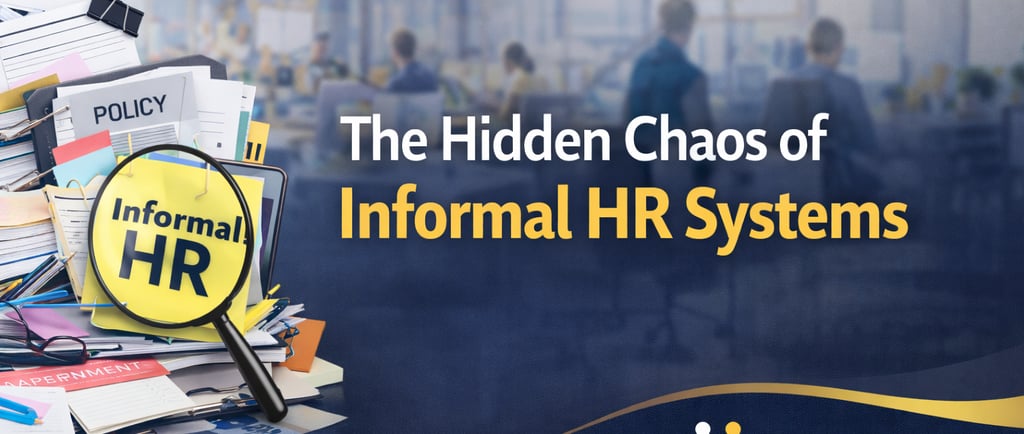
The Hidden Chaos of Informal HR Systems
In many growing businesses, human resource management begins informally, and understandably so. In the early stages, flexibility feels efficient. Decisions are quick. Communication is direct. There are no complex systems slowing things down.
But as the organization grows, what once felt “simple” quietly becomes chaotic, inconsistent, and costly.
The danger is this: informal HR systems rarely fail loudly. They fail silently,through missed opportunities, poor hires, disengaged employees, and operational inefficiencies that accumulate over time.
What Is an Informal HR System?
An informal HR system exists when people-related processes,such as hiring, performance management, compensation, and policies,are handled without structure, documentation, or clear strategy.
Instead of systems, businesses rely on:
Memory instead of records
Conversations instead of policies
Urgency instead of planning
Assumptions instead of data
At small scale, this may work. At growth stage, it becomes a liability.
The Research Reality: Informality Comes at a Cost
Research consistently shows that informal HR practices are linked to weaker outcomes across organizations.
According to studies on small and medium enterprises, informal HR systems are associated with higher employee turnover, absenteeism, and reduced performance levels. In contrast, organizations with structured HR practices demonstrate stronger operational performance and workforce stability.
Additionally, research in HR management reveals that businesses with well-defined HR systems outperform those with minimal or inconsistent practices, particularly in areas such as productivity, retention, and employee engagement.
At the same time, industry data indicates that approximately 36% of small to mid-sized businesses operate with little to no formal HR systems or supporting technology. This lack of structure significantly limits their ability to make informed, data-driven decisions.
This is not just a systems issue, it is a business performance issue.
Where the Chaos Shows Up (Even When You Don’t See It)
The effects of informal HR systems are often subtle at first, but they become visible through patterns:
🔹 1. Inconsistent Hiring Decisions
Without structured recruitment processes:
Hiring becomes reactive rather than strategic
Job roles are unclear or undefined
Selection is based on subjective judgment instead of measurable criteria
➡️ Result: Poor hiring decisions and increased turnover
Research suggests that a single poor hiring decision can cost businesses thousands in lost productivity, training, and replacement costs.
🔹 2. Undefined Roles and Expectations
When roles lack clarity:
Responsibilities overlap
Accountability becomes blurred
Employees are unsure of expectations
➡️ Result: Confusion, inefficiency, and frustration within teams
🔹 3. Weak Performance Management
Without clear systems:
Feedback is inconsistent or absent
High performers are not recognized
Underperformance is not addressed
➡️ Result: Declining standards and reduced motivation
🔹 4. Compliance and Legal Exposure
Informal HR often overlooks:
Labour regulations
Documentation requirements
Proper record-keeping
➡️ Result: Increased risk of disputes, penalties, and reputational damage
🔹 5. Employee Development Gaps
Without structured development:
Training is inconsistent
Career growth pathways are unclear
Employee development is left to chance
➡️ Result: Stagnation and talent loss
According to workforce studies, 48% of employees consider career development opportunities a key factor when choosing or remaining with an employer.
🔹 6. Decision-Making Without Data
Informal systems lack:
HR metrics
Performance tracking
Workforce analytics
➡️ Result: Decisions are based on assumptions rather than insight
The Illusion of “It’s Working Fine”
One of the greatest risks of informal HR systems is that they appear to function effectively—until they don’t.
In reality:
Problems are delayed, not avoided
Inefficiencies are hidden, not eliminated
Growth is limited, not supported
Many organizations only recognize the problem when:
Turnover increases
Productivity declines
Hiring challenges escalate
By then, the cost is already significant.
Why Structure Changes Everything
Organizations with structured HR systems consistently demonstrate:
Stronger employee retention
More effective hiring outcomes
Improved performance management
Greater long-term sustainability
Structure does not eliminate flexibility, it provides clarity, consistency, and control.
Moving From Informal to Intentional
Transitioning to structured HR does not require complexity,it requires clarity.
Start with:
Clearly defined job roles and responsibilities
Standardized hiring and selection processes
Basic performance management frameworks
Documented workplace policies
Simple tracking of key HR metrics
Small, consistent systems create long-term stability and growth.
Final Insight
The real issue is not that informal HR systems exist, it’s that they are left unmanaged for too long.
What begins as flexibility becomes:
inconsistency
inefficiency
and eventually, instability
The organizations that grow sustainably are not just hardworking, they are structured.
You don’t build strong organizations on effort alone, you build them on systems that sustain performance.
References
UKG & HR.com (2023). HR Challenges in Small and Mid-Sized Businesses Survey
Journal of Small Business Strategy. Human Resource Practices and Firm Performance
Walden University Research. Impact of HR Systems on Organizational Effectiveness
Workforce Development Studies. Employee Retention and Career Growth Trends
HR Industry Reports on Recruitment Costs and Workforce Productivity