
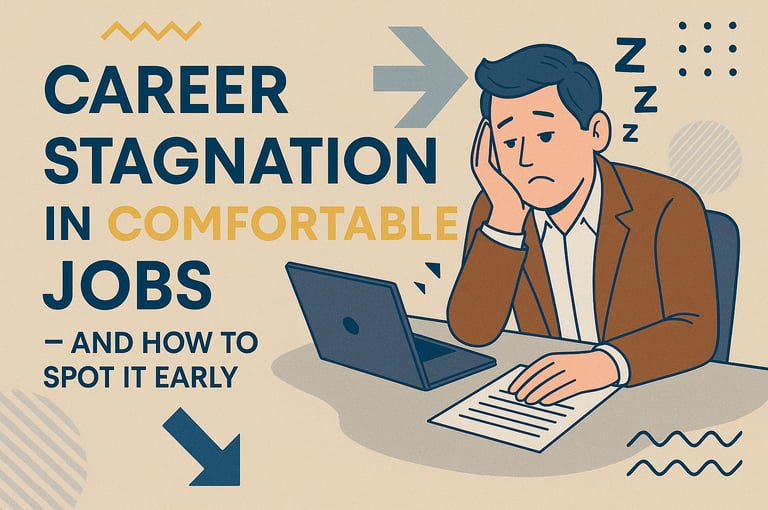
Career Stagnation in Comfortable Jobs — and How to Spot It Early
Not all career stagnation feels negative. Sometimes it arrives quietly through comfort and stability. This article helps employees recognise early signs of stagnation and take thoughtful steps before momentum is lost.
CAREER DEVELOPMENT & JOB SEARCH
12/22/20251 min read
When Stability Quietly Replaces Progress
Career stagnation rarely arrives with dissatisfaction.
More often, it settles in wearing the disguise of comfort.
The job is manageable. The environment is familiar. Expectations are clear. There’s no immediate pressure to leave — and that’s exactly why stagnation can go unnoticed for years.
What Career Stagnation Really Looks Like
Stagnation isn’t about inactivity — it’s about lack of movement.
Common signs include:
Minimal skill development despite steady workload
Repeating the same responsibilities year after year
Reduced curiosity or challenge
Comfort paired with subtle disengagement
Performance remains stable, but growth slows quietly in the background.
Why Comfortable Jobs Can Be Risky
Comfort creates predictability — and predictability reduces urgency.
When roles stop stretching capabilities:
Skills plateau
Confidence becomes role-specific
Adaptability weakens
Future transitions feel intimidating
The longer this lasts, the harder it becomes to re-engage momentum.
The Psychological Trap of “It’s Fine for Now”
Many employees delay action because:
The job isn’t bad
Change feels unnecessary
Other priorities feel more urgent
Growth is postponed, not abandoned
But postponed growth often turns into missed opportunity rather than intentional choice.
Early Warning Signs Worth Paying Attention To
Career stagnation often surfaces as:
A lack of stories when asked about recent learning
Difficulty articulating next steps
Reliance on tenure instead of capability
Comfort becoming the main reason for staying
These signals don’t mean failure — they signal a need for recalibration.
How to Address Stagnation Without Upheaval
1. Revisit What Growth Means to You
Growth doesn’t always mean promotion — it can mean mastery, variety, or relevance.
2. Introduce Controlled Discomfort
Small challenges restore momentum: new projects, learning goals, or cross-functional exposure.
3. Track Learning, Not Just Output
Progress is easier to notice when you document capability development.
4. Have Early, Low-Stakes Conversations
Discuss growth before dissatisfaction appears — not after.
Choosing Intention Over Inertia
Comfort isn’t the problem.
Staying unaware is.
Careers thrive when stability is paired with curiosity and intentional development. Spotting stagnation early preserves choice, confidence, and future flexibility.